The 2026 long-distanc traffic timetable in Germany is dominated by systematisation. The trains show fewer differences regarding the routes and stops. As I only show connections occurring at least three times a day, this systematisation leads to more lines on my diagram: some single trains that haven’t been shown before, are now grouped together, as they run at least three times a day. In addition, there are fewer trains differing from the regular route. However, the latter effects cannot been seen on the diagram. This is why not all major changes can be seen while comparing with the 2025 long-distance train diagram.
There are more ICE Sprinter trains between Hamburg and Cologne, Hamburg and Frankfurt as well as between Berlin and Frankfurt. The ICE Sprinter connections between Berlin and Munich have been systematised. There are fewer trains on the lines 26 (Karlsruhe-Frankfurt-Gießen-Kassel-…) and 34 (Frankfurt-Siegen-Dortmund). From 2026, only two daily trains of the line 61 are extended from Nuremberg to Leipzig. Instead of dividing ICE trains of the line 25 to Bremen, line 26 is routed to Bremen and a new line Bremen-Hannover-Berlin is introduced. There are more trains to Poland, Belgium, Denmark and Switzerland.
Please also make sure to see the diagram showing the long-distance night trains.
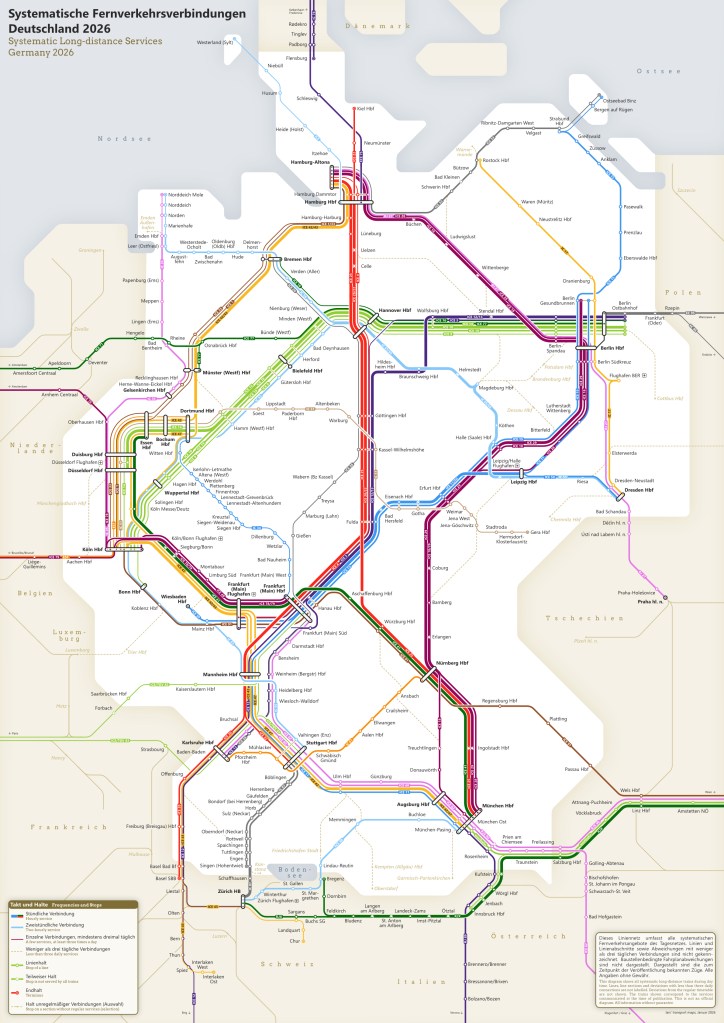
DB’s official diagram:
ICE/IC Network Map 2026
 lars' transport maps
Great work again, beautiful map! One little correction: since the new time table ICE 77 (Amsterdam – Berlin) don’t end in Berlin Ostbahnhof but in Berlin Hbf (tief), so you can cut the green line of line 77 between Berlin Hbf and Berlin Ostbahnhof.
LikeLike
Thank you for your comment! I was confused about the regular stops for ICE 77 (and ICE 14) due to the different construction work periods. Some trains also start from Südkreuz. The least confusing thing to do, I guess, is to indicate Berlin Hbf as the terminus for lines ICE 14 and 77.
LikeLike
So viel besser lesbar. Die Bahn sollte dich einstellen, wenn du die Strecken so automatisiert generieren kannst.
LikeLike
I swear DB should hire you. You should seriously make one for NordRhein Westfalen. Theirs sucks. Also how do you make these maps
LikeLike