
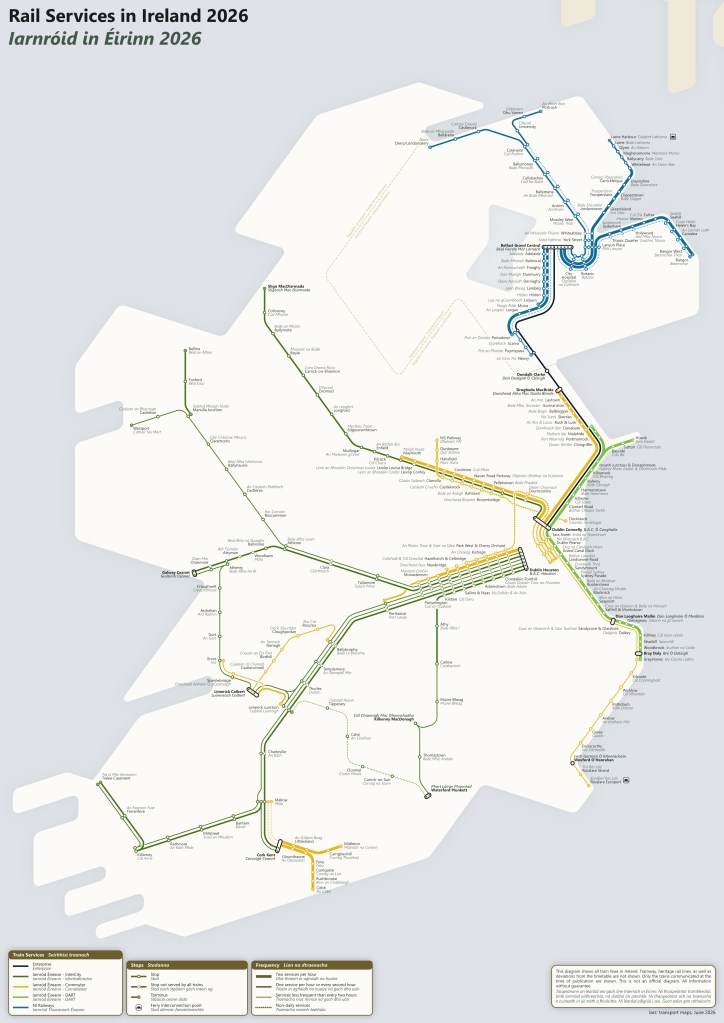
After more than 1.5 years, it is time for a new diagram again: Ireland. For this island, I have opted for a slightly more specialised grid structure with 36° angles. This allows for an axis-symmetrical representation of the main line along the east coast near Dublin, the Dublin–Sligo and Dublin–Cork lines, and various other symmetrical elements. Otherwise, mapping the rail services of this island nation is no trivial task for a number of reasons.
Above all, the density of the rail network varies greatly. There are the very dense, urban areas of Dublin and Belfast with a dense network of stations. In contrast, there are the few connections on the sparsely populated remaining rail lines leading from the east coast to the west and south.
The only solution is to excessively enlarge the two metropolitan areas of Belfast and Dublin along the east coast. This scaling also extends westwards from Dublin, which must be compensated for by the structure of the routes.
Equally problematic are the train categories in Ireland, which are not used systematically. IE uses DART, Commuter and InterCity. However, there is no clear distinction between the latter two (vehicle types differ from their timetables or other specifications).
The lines around Dublin, Cork and Limerick are designated as Commuter, the rest as InterCity. If anyone knows of any more consistent categorisations, please do get in touch.
Bilingualism is another challenge for my diagram. Unlike in other countries for which I have created rail networks (Belgium, Finland, Switzerland), this is not a case of historical regional multilingualism, as Irish was the majority language throughout the island. Consequently, bilingualism is politically charged.
For this reason, all station names are given in both languages. As with IE diagrams, I have placed both languages one above the other, and sometimes side by side due to lack of space. As on IE signs, Irish is shown in italics. If there are any language errors, please let me know.


Beautiful! And very helpful too.
LikeLike
Thank you! Great Inspiration and quite handy for my Interrail-trip to Ireland this Year.
LikeLike